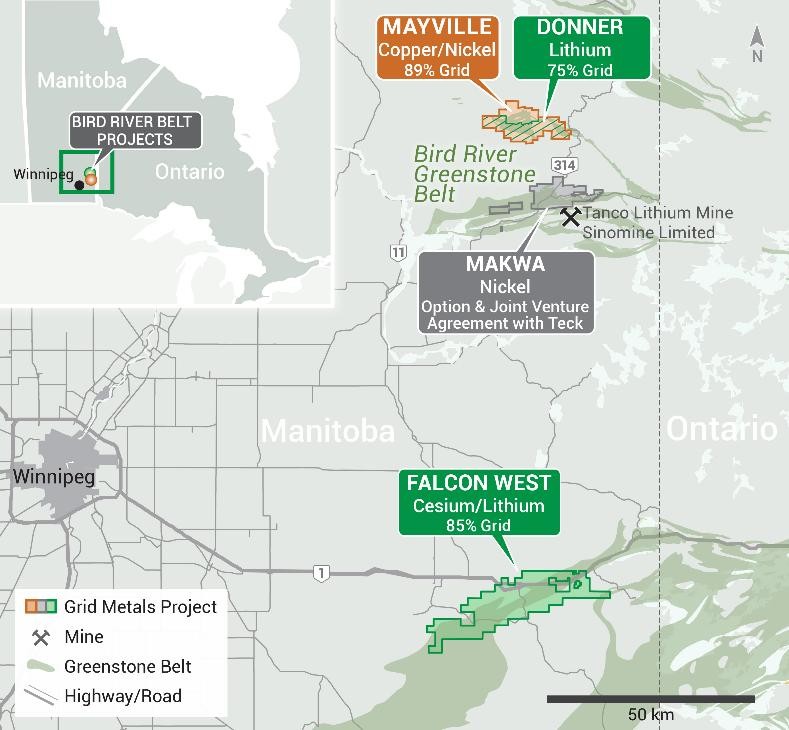
Above: Map of southeastern Manitoba showing the Falcon West cesium project.
Falcon West covers the next prospective greenstone belt south of the world-class Tanco mine which operates North America’s only cesium chemical plant. The project is 85%-owned by Grid with minority partner Avenir Minerals, a subsidiary of Agnico Eagle Mines. Avenir has the right to increase its project interest to 30% upon completion of a Preliminary Economic Assessment (“PEA”) or adoption of a Mine Plan.
The project contains an open pit measured resource for the Lithium-Cesium-Tantalum (“LCT”) Zone of 51,500 tonnes at 2.58% Cs2O and 1.47% Li2O which includes a higher-grade cesium-rich Pollucite Zone containing a measured resource of 15,600 tonnes at 5.19% Cs2O and 1.76% Li2O (see press release dated September 30, 2026 HERE). This resource at Lucy South firmly establishes Lucy South as the second largest cesium resource being actively developed globally by western-domiciled exploration and development companies1.
Lucy South represents a rare global occurrence of a cesium-bearing pollucite pegmatite, and it is estimated that only three primary cesium mines have ever operated2. Cesium has been designated a critical metal by the US and Canadian governments based on supply chain vulnerability.
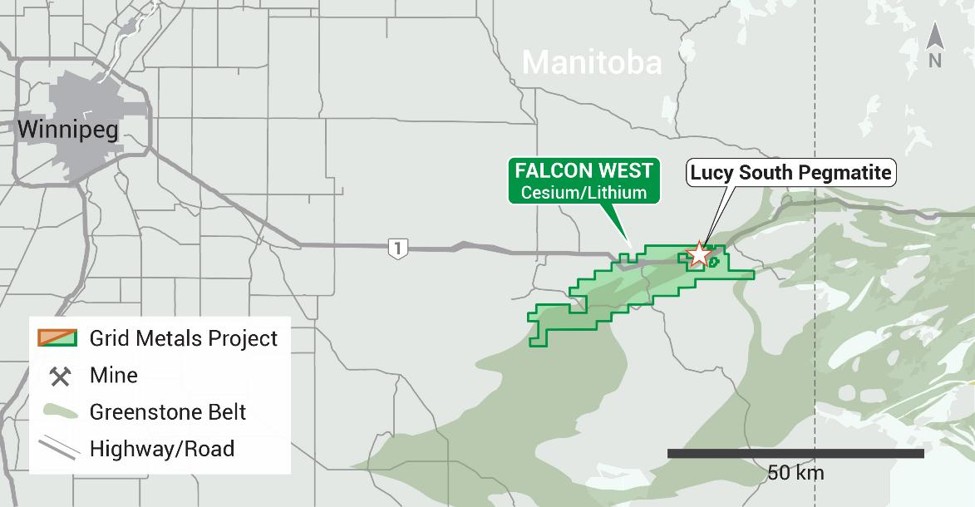
Above: Falcon West Lithium Property regional map.
Mineral Resource Estimate
The MRE was prepared by SGS Canada Inc. ("SGS") in compliance with National Instrument 43-101 – Standards of Disclosure for Mineral Projects ("NI 43-101") and the CIM Definition Standards, and is supported by a technical report to be filed on SEDAR+ within 45 days of the news release.
The Lucy South cesium zone forms part of a ~10-metre-thick, near-surface, highly fractionated cesium-lithium-tantalum-enriched pegmatite located in the northeastern portion of the Falcon West Property. The host Lucy South pegmatite is one of three known LCT pegmatite occurrences along the >1 km x 250 m Artdon-Lucy ('ADL') trend. Resource delineation drilling completed in the Phase 1 and Phase 2 programs (2025–2026) has defined the cesium-enriched Pollucite Zone over an area of approximately 120 m x 50 m, at an average drill spacing of 5 to 10 metres. The Pollucite Zone is enclosed by a thicker cesium + lithium + tantalum-enriched core zone occupying the middle portions of the Lucy South pegmatite. The Pollucite Zone remains partly open to the northeast, southeast and southwest.
Table 1 sets out the Mineral Resource Estimate for the Lucy South cesium-lithium-tantalum deposit.
TABLE 1. Lucy South Mineral Resource Estimate.
| Cut-Off Grade (Cs2O%) | Zone | Classification | Tonnes | Grade Cs2O% | Grade Li2O% | Tonnes Cs2O | Tonnes Li2O |
| 0.2 | LCT | Measured | 51,500 | 2.58 | 1.47 | 1,322 | 756 |
| Including: | |||||||
| 0.2 | Pollucite | Measured | 15,600 | 5.19 | 1.76 | 811 | 275 |
- The effective date of the Lucy South Mineral Resource Estimate is the 25th September, 2026.
- The mineral resource was estimated by Rohan Millar, P.Geo., of SGS Geological Services, an independent Qualified Person as defined by NI 43-101.
- The classification of the current Mineral Resource Estimate into Measured mineral resources is consistent with current 2014 CIM Definition Standards - For Mineral Resources and Mineral Reserves.
- Figures are rounded to reflect the relative accuracy of the estimate and numbers may not add due to rounding.
- The mineral resources are presented undiluted and in situ, constrained by continuous 3D wireframe models, and is considered to have reasonable prospects for eventual economic extraction.
- Mineral resources which are not mineral reserves do not have demonstrated economic viability. An Inferred Mineral Resource has a lower level of confidence than that applying to an Indicated Mineral Resource and must not be converted to a Mineral Reserve. It is reasonably expected that most Inferred Mineral Resources could be upgraded to Indicated Mineral Resources with continued exploration.
- The Lucy South mineral resource estimate is based on a validated database which includes data from surface diamond drilling completed between 2012 and 2026.
- Grades for Cs and Li were estimated using 0.5 metre composites. To generate grade within the blocks, the inverse distance squared (ID2) interpolation method was used. An average specific gravity ('SG') of 2.79 g/cm3 was used for the Pollucite Zone, an SG of 2.84 g/cm3 was used for the spodumene-rich halo and an SG of 2.77 g/cm3 was used for the remaining pegmatite.
- Based on the location, surface exposure, size, shape, general true thickness, and orientation, it is envisioned that the Lucy South deposit may be mined using open-pit mining methods. In-pit mineral resources are reported at a base case cut-off grade of 0.2 Cs2O%. The in-pit resource grade blocks are quantified above the base case cut-off grade, above the constraining pit shell, below topography and within the constraining mineralized domain (the constraining volume).
- The pit optimization and base-case cut-off grade consider a 100% Cs2O metal price of $30,000/t and a 6% Li2O concentrate price of $1,500/t and considers a Cs recovery of 80% and Li recovery of 80%. The pit optimization and base case cut-off grade also considers a mining cost of US$10.00/t mined, pit slope of 60⁰ degrees, and processing, treatment, refining, G&A and transportation cost of USD$53.00/t of mineralized material.
- The results from the pit optimization are used solely for the purpose of testing the “reasonable prospects for economic extraction” by an open pit and do not represent an attempt to estimate mineral reserves. There are no mineral reserves on the Property. The results are used simply as a guide to assist in the preparation of a mineral resource statement and to select an appropriate resource reporting cut-off grade. A pit shell at a revenue factor of 1.00 was selected as the ultimate pit shell for the purposes of the current MRE.
- The estimate of Mineral Resources may be materially affected by environmental, permitting, legal, title, taxation, socio-political, marketing, or other relevant issues.
Footnotes
- Power Metals Corp and PMET Resources are actively developing pollucite-bearing cesium projects. Power Metals’ Case Lake project has an open pit inferred mineral resource of 13,000 tonnes at 2.4% Cs2O and 1.3% Li2O. PMET’s Shaakichiuwaanaan project has open pit resources across two zones (Rigel and Vega) hosted within the open pit resource of its CV13 pegmatite.
- The only three cesium mines that are believed to have operated are Tanco in Manitoba, Bikita in Zimbabwe, and Sinclair in Australia. The resources at Sinclair were exhausted in 2019, and it is understood that Tanco and Bikita are approaching the end of mine life for cesium with only tailings extraction and remnant mining being undertaken.